Owing to historical anomalies, the Kowloon Walled City had long remained an ungoverned enclave neglected by both the Chinese and British authorities. Dominated by powerful triad syndicates, its rampant trade in vice, gambling, and narcotics made this plot of less than three hectares synonymous with slum squalor and crime in a singular era. Even the colonial police refused to set foot inside.
In the real world, the Walled City had been demolished in 1993 to make way for a park, so Kiu Man had never seen the legendary slum with his own eyes. Yet its mythos had endured across generations, serving as an endless well of inspiration for writers and a holy land for cyberpunk enthusiasts.
Just then, a commercial airliner descending toward Kai Tak Airport roared directly over the tenement rooftops, casting a massive, fleeting shadow across the alley.
Kiu Man was reminded of how William Gibson, the father of cyberpunk, once captured this place: "The Citadel stands at the end of a runway, waiting to be cleared. It had been home to butchers, unlicensed dentists, and drug dealers... Those cluttered windows were like nests of dreams; they seemed to absorb all the mad vitality of the Kai Tak airport; they sucked up energy like black holes."
It was a city within a city that had fueled the imagination of countless artists. Yet there was a vast gulf between artistic romanticism and lived reality.
Standing in the flesh amidst the grime, even an experienced adventurer like Kiu Man felt an inescapable sense of oppression and unease settle over his chest.
In his previous life, he had grown up under comfortable skies with ample wealth, never wanting for basic comforts. His expeditions had taken him across scorched deserts and dense jungles, but he had never ventured into a true urban slum.
Now, he was not merely an observer -- he was part of it.
It was, in a grim way, quite an adventure.
He calculated the timeline in his head. The year was 1972 -- two full years before the colonial police would launch organized patrols inside the enclave. This meant the Walled City was currently enduring its darkest, most lawless era.
Fortunately, having inherited the memories of his predecessor and possessing foresight from the novel, he did not lose his composure.
As his thoughts raced, Ah Ho interrupted from his side. "Oh, by the way, Ah Man. Since you are awake, should you head home to check in with Granny first? You were unconscious for so long that Uncle Wah thought you would not make it. Brother Nam and I did not dare tell her the truth; we only said you caught a chill and could not be exposed to the draft, telling her to stay away for a couple of days."
The memory clicked into place. The original youth was an orphan who had depended on his maternal grandmother since childhood. She ran a modest dry-goods stall to scratch out a living and raise her sickly grandson. In return, the young Kiu Man had been studious and well-behaved, unlike most youths in the Walled City who drifted into street gangs. He excelled in his studies and had just completed his Form Five examinations. Due to their dire finances, he had given up on university, intending instead to find steady, reputable employment to support the household.
Before he could even submit a resume, a sudden collapse had claimed his life -- leaving the modern Kiu Man in his place.
Kiu Man considered the situation and said, "Ah Ho, I want to step outside the Walled City to get some fresh air. Go find Granny and let her know I am on the mend so she stops worrying. It is almost closing time for the stalls -- lend her a hand while you are at it."
Ah Ho frowned with concern. "You are going out on your own? How can I leave you? What if you collapse on the street and no one helps you?"
Kiu Man turned, meeting the boy’s worried gaze with a faint, reassuring smile. He rested a hand on Ah Ho’s shoulder. "I will be fine. Do not fret. You have been running yourself ragged taking care of me these past few days. Help Granny close up the stall and get some rest early."
Ah Ho stared blankly at him. Kiu Man had always worn a weary, melancholy expression burdened by chronic illness; Ah Ho could not remember the last time he had seen him smile. That simple upturn of his lips seemed to part the overcast sky above them.
Ah Ho could tell that Ah Man felt completely different today, though he lacked the words to articulate why. Yet the change brought him a warm sense of relief. He nodded submissively. "Then take care of yourself. And do not forget to come back to Uncle Wah's clinic to drink your herbal brew."
"I know."
Ah Ho turned to leave, but Kiu Man called out once more, "Do you have any cash on you?"
"Just ten dollars."
"Give it to me."
Taking the crumpled bills, Kiu Man watched the boy hurry down the corridor before turning toward the enclave's boundary based on the original owner’s memories.
The Walled City was divided into two distinct zones. The Western District housed ordinary, law-abiding working-class families, while the Eastern District served as the triad stronghold -- a den of brothels, gambling dens, and opium parlors where ordinary folk never dared wander.
The syndicate controlling the enclave was known as the Wo Hing Society, boasting descent from the historic Hong Kong triad lineages. Its current leader was Chiu Shan Hoi, notoriously known by the moniker The Prowling Leopard, or Master Leopard -- a ruthless and cold-blooded figure.
Within the wider expanse of Hong Kong, the Wo Hing Society numbered fewer than a thousand members and was technically considered a second-tier gang. Yet because the Walled City remained entirely outside police jurisdiction, their territory was uniquely dangerous. Even if their men committed murder or arson outside, fleeing back through the Walled City gates granted them absolute immunity. As a result, no outside rival dared provoke them, making the Wo Hing Society the most arrogant syndicate in the city.
Because they held absolute sway inside the enclave, many young toughs considered joining their ranks a point of pride. A quiet, bookish boy like Kiu Man was practically an endangered species.
Chan Ka Nam, naturally, had enlisted as a member of the Wo Hing Society.
In Kiu Man’s inherited memories, the original owner had fiercely resented Chan Ka Nam running with the triads, which had once led to a massive argument between them. The rift only healed when Chan Ka Nam swore that he had joined solely to protect their neighborhood from outside bullies and would never touch gambling or narcotics.
But then, no one could walk along the riverbank forever and expect to keep their shoes dry -- least of all in a chaotic era like this.
Currently, Chan Ka Nam was merely a bottom-tier Four-Nine Boy within the Wo Hing ranks. But if tonight’s assassination went through, Chiu Shan Hoi would immediately promote him to a Red Pole fighter. And once he became a Red Pole, the blood on his hands would only multiply.
Kiu Man recalled the novel's depiction of Chan Ka Nam's later atrocities -- he had been an absolute berserker on the streets. Had the original youth survived, even he would likely have failed to steer Chan Ka Nam away from his bloody descent into villainy.
Exhaling softly, Kiu Man navigated the damp, shadowy alleyways.
The enclave was compact; within minutes of steady walking, he emerged beyond its outer perimeter.
Stepping past the threshold was like crossing between two separate worlds. Behind him lay a subterranean slum cast in perpetual darkness; before him stretched a vibrant, modern metropolis bathed in twilight.
His eyes swept over a row of yellow rickshaws idling by the curb.
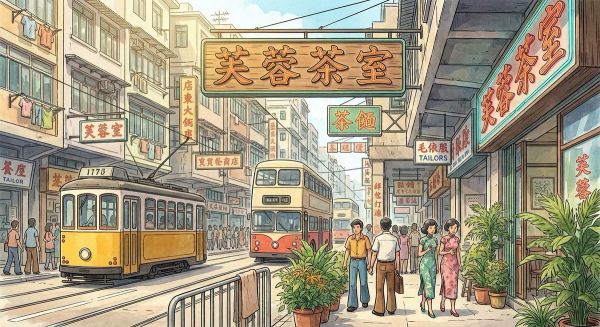
Though buses, trams, public light buses, and motorized taxis had become ubiquitous by the early 1970s, cheap and accessible rickshaws remained a vital lifeline for lower-class laborers making a living.
Kiu Man gauged the distance to his destination. It was not terribly far -- about twenty minutes on foot for a healthy adult. But in his current depleted state, walking five minutes had already brought him to the brink of collapse.
Clutching the ten-dollar bill tightly in his palm, he approached an idle rickshaw and rasped to the driver, "Fu Yung Teahouse, Yau Ma Tei."
Tonight was not merely the turning point for the villain Chan Ka Nam -- it was the day the male lead, Lam Tsz Fai, met his own defining tragedy.
The wealthy merchant about to be struck down was Lam Siu Ming. To provide the typical angst of a novel protagonist, Lam Tsz Fai was not a recognized legitimate heir, but the illegitimate child born of a liaison between Lam Siu Ming and a teahouse hostess.
Following the classic tragic trope, Lam Tsz Fai's biological mother had succumbed to illness shortly after childbirth. His wealthy father, having built his empire through his influential wife's family, dared not bring a bastard child into his household. Thus, Lam Tsz Fai had been left in the care of his maternal uncle, who operated a traditional teahouse.
Though never officially acknowledged by the high-society Lam clan, Lam Siu Ming had treated the boy generously with private financial allowances, granting him a comfortable upbringing that was worlds apart from the slum existence of Chan Ka Nam and Kiu Man.
In the original plot, once the wealthy father was murdered, the private funding dried up instantly. Lam Tsz Fai’s gambling-addicted uncle quickly squandered the teahouse, fell critically ill, and died without funds for medical care. Stripped of all support, Lam Tsz Fai was ruthlessly suppressed by his father’s legitimate widow and children, enduring years of bitter hardship.
Of course, being the chosen protagonist, he rose through the adversity, steadily retaliating against every adversary who crossed him until he climbed from penniless outcast to a city tycoon.
His journey mirrored Chan Ka Nam’s in many ways: both forged by hardship to become kings of their domains, except one walked the path of light while the other drowned in the underworld. And because Lam Tsz Fai possessed the plot armor of a hero, his path was ultimately triumphant, leaving the villain existing solely as a stepping stone to be repeatedly outmatched and broken.
When Kiu Man had skimmed the novel in the desert, Chan Ka Nam’s continuous defeats against the protagonist had felt narrative-driven and illogical. Chan Ka Nam had climbed from a bottom-tier Four-Nine to an elite Double Flower Red Pole in just two short years. He had subsequently taken advantage of a government crackdown to eliminate Chiu Shan Hoi, seize the head seat of the Wo Hing Society, and expand their empire beyond the Walled City across all of Hong Kong -- laundering their wealth into prime real estate and entertainment while driving illicit rackets underground, all before turning twenty-five.
For such a cunning, formidable mastermind to repeatedly stumble before Lam Tsz Fai and end up dead under a hail of bullets felt entirely unnatural.
Yet in the realm of power-fantasy fiction, cold logic always bowed before the hero’s halo.